She walked 20,000 steps every day for a whole month and this is what happened to her body
|









Walking is considered one of the simplest ways to bring more movement into your life. You don't need a gym membership, special equipment, or a complicated workout plan – just put on your shoes and start walking.
But what happens when you don't settle for a few thousand steps a day and instead decide to reach 20,000 steps every day for an entire month?
That is exactly the challenge health and fitness content creator Ilva Ignatovica took on. For 30 days, she made sure to reach this huge daily target and documented how the new routine affected her body, weight, mood – and even her free time.
The result was an interesting combination of benefits and drawbacks: she lost weight, enjoyed the walks, and felt a strong sense of accomplishment – but she also developed back pain and discovered that walking, even in huge amounts, is no substitute for strength training and stretching.

20,000 steps are far more than they sound
On paper, the number 20,000 might sound like a goal you could reach simply by moving around a little more during the day.
In reality, it represents a very significant amount of walking.
For most people, 20,000 steps translates to roughly 13 to 16 kilometers (8 to 10 miles) a day, depending on stride length and walking speed. Ilva said that on some days, it took her around four hours to reach her target.
And when you dedicate four hours a day to walking, it is no longer just another small habit.
It becomes a major part of the day.
You have to find time before work, after work, or during the day, plan routes, and keep walking even when you don't feel like it.
Ilva was already accustomed to walking around 10,000 steps a day before starting the challenge, so she wasn't starting from zero. Even so, doubling that amount required a significant change to her routine.
At first, everything felt positive
One of the things Ilva particularly enjoyed was the time she spent outdoors.
Walking allowed her to disconnect, think, and stay active without the intensity of a hard workout.
In a video documenting the challenge, she described benefits such as reduced stress and anxiety and a greater sense of mental clarity, along with simply enjoying the walks themselves.
After weeks of sticking with the challenge, she also felt a strong sense of pride.
She had set herself a goal that required discipline every single day – and she didn't give up on it.
But the most noticeable change from the outside showed up on the scale.

After a month, she had lost about two kilograms
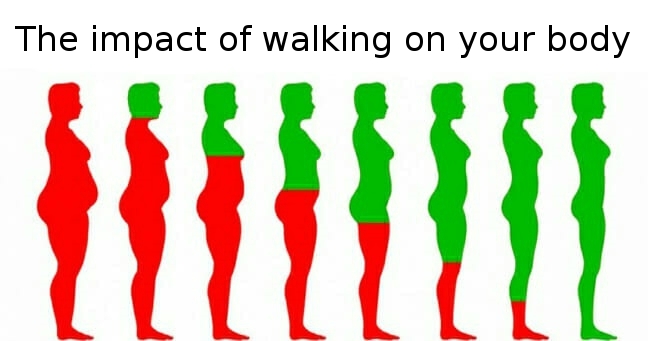
As the challenge came to an end, Ilva said she had lost approximately two kilograms (4.4 pounds).
She was pleased with the result, but the weight loss wasn't the only thing that made her feel the challenge had been successful.
"I felt proud of my determination, grateful for the beautiful walks, and happy about the two kilograms I had lost," she said.
It's important to remember that one person's change in weight is not a prediction of what will happen to everyone who walks 20,000 steps.
Body weight is influenced by diet, age, muscle mass, metabolic rate, starting weight, walking speed, and many other factors. Physical activity can help with weight loss or weight maintenance, but the amount needed varies from person to person.
But then the back pain started
Despite all the benefits, the challenge did not go perfectly.
Ilva began experiencing back pain.
At first, it might have been easy to assume that the problem was simply caused by too much walking, but her own takeaway was different.
"I experienced some back pain and quickly realized that just because I'm walking so much doesn't mean I can skip stretching and strength training," she said.
And that may have been the most important lesson she took away from the entire month.
Walking is an excellent form of exercise – but it doesn't do everything.
She almost unknowingly stopped doing some of her strength workouts
The problem wasn't just that the walks took up time.
They began pushing other things out of her routine.
To complete 20,000 steps every day, Ilva had to spend hours walking. As a result, she had less time for the strength and fitness workouts she had previously been doing.
And this created an interesting paradox.
She was more active than ever in terms of step count – but at the same time, she was neglecting another part of her physical fitness.
Strength training is important for maintaining muscle mass, everyday function, and bone health, so walking is not necessarily meant to completely replace it. Physical activity guidelines also do not focus solely on step counts, but combine aerobic activity with muscle-strengthening activity.
10,000 steps are not a magic number
For years, we've all heard that we should reach 10,000 steps a day.
But that number isn't a "health line" where 9,999 steps aren't enough and 10,000 suddenly makes us healthy.
The U.S. physical activity guidelines also note that 10,000 steps is a popular target, not an official recommendation in itself. The basic recommendations for adults focus primarily on at least 150 minutes of moderate-intensity physical activity per week, along with muscle-strengthening activity.
Research in recent years has also shown that significant benefits can be achieved well before reaching 10,000 steps.
The major study that found 7,000 steps already make a huge difference
A large meta-analysis published in The Lancet Public Health in 2025 examined dozens of studies on daily step counts and a wide range of health outcomes.
Compared with people who walked around 2,000 steps a day, walking approximately 7,000 steps was associated with a 47% lower risk of death from any cause, a 25% lower risk of developing cardiovascular disease, and a 38% lower risk of dementia.
Positive associations were also found with lower risks of type 2 diabetes, depressive symptoms, cancer mortality, and falls.
The researchers concluded that around 7,000 steps a day may be a more practical and realistic target for many people, while 10,000 steps can still be an excellent goal for people who are already active and want to do more.
So if 7,000 is good – does that mean 20,000 is automatically three times better?
No.
And that's an important point.
With physical activity, there generally isn't a simple relationship in which doubling the number of steps doubles the benefits.
The 2025 study found that health risks continued to decline with higher step counts for some outcomes, but for several outcomes, the benefits appeared to level off around 5,000 to 7,000 steps per day.
The CDC also notes that previous research found the risk of premature death tended to level off around 8,000 to 10,000 steps among adults under 60, and around 6,000 to 8,000 among people aged 60 and older.
Therefore, 20,000 steps can be a fun personal goal or fitness challenge – but most people do not need to reach that number to enjoy the health benefits of walking.
One of the biggest costs was actually time
It's easy to focus on the two kilograms Ilva lost, but one of the most striking aspects of her experiment was actually the time it required.
Four hours of walking a day adds up to 28 hours a week.
Almost another part-time job.
For someone working full-time, caring for children, or simply wanting to fit in other workouts and a social life, such a target can be extremely difficult to maintain.
And that's exactly what Ilva experienced.
As the hours she devoted to walking increased, she had less time for other things – including types of exercise that had been part of her routine before the challenge.
Her message in the end wasn't that everyone should start walking for four hours a day.
It was that the body needs balance.
What surprised her most wasn't just the physical change
After an entire month, Ilva wasn't talking only about kilograms.
A large part of her experience was mental.
Meeting the target every day gave her a sense of accomplishment.
The walks gave her time outdoors.
And sticking with the challenge proved to her that she could commit to a difficult goal and keep going even when she wasn't motivated.
Physical activity in general is associated with a range of mental health benefits. The CDC notes that physical activity can help reduce feelings of anxiety, improve sleep quality, and lower the long-term risk of depression.
So some of the improvement Ilva felt may not have been related to the magic number 20,000 at all – but simply to the fact that she went outside and stayed active consistently every day.
Other people started sharing what happened to them, too
After her video was published, people who had also changed the amount they walked began sharing their own experiences.
One person wrote that they had walked 20,000 steps a day for six weeks – 8,000 in the morning, 8,000 in the evening, and the rest during the workday – and claimed that it completely changed their health metrics.
Another person said they had managed to improve a prediabetes condition by combining additional walking with reducing their intake of high-sugar foods.
These are, of course, personal stories rather than medical trials, so they cannot tell us what will happen to other people. But they reflect something that repeatedly appears in research: moving from a sedentary lifestyle to more physical activity can have a significant impact on health.
You don't need to start with 20,000
Someone reading this story might suddenly feel that they need to get up and walk 20,000 steps tomorrow – but that could miss the main point.
A person who currently takes 2,000 or 3,000 steps a day can probably gain significant benefits from a much smaller increase.
The CDC emphasizes that any amount of moderate- to vigorous-intensity physical activity can provide benefits, and that even adding 10 minutes of activity a day can make a difference.
So a good goal isn't necessarily the highest number you can achieve.
It's a number you can maintain without causing pain, excessive fatigue, or forcing you to give up other important aspects of your health.
After 30 days, she was two kilograms lighter – and had learned a much more important lesson
At the end of the challenge, Ilva got the result that many people would focus on immediately: she was about two kilograms lighter.
But she also came out of the month with back pain and the realization that walking alone is not a complete fitness program.
The 20,000 steps gave her hours of movement, time outdoors, a sense of accomplishment, and weight loss.
But four hours of walking a day caused her to give up strength training and stretching – and eventually, her body reminded her that it needed those things, too.
And that may be the most interesting conclusion from her experiment.
You don't have to choose between being someone who sits all day and someone who walks 20,000 steps.
You can simply walk more.
7,000 steps.
8,000.
10,000.
Or even a few hundred more than you did yesterday.
Ilva discovered that walking 20,000 steps a day can change the body – but she also discovered that real fitness isn't simply a question of how far you've walked. Sometimes the healthiest approach isn't to do as much as possible, but to find an amount of movement that you can realistically incorporate into your life for the long term.